Instrumentation | PLC | Tutorials— Click here to visit
Imagine a chemical reactor operating at high pressure, where even a slight overflow could trigger a catastrophic chain reaction. Or picture a water treatment plant where precise level control ensures millions receive clean water daily. In these scenarios and countless others across industries, level measurement isn’t just a technical requirement—it’s the invisible guardian of safety, efficiency, and operational excellence.
Level measurement technology has evolved dramatically from simple float switches to sophisticated radar systems that can “see” through foam, vapor, and extreme temperatures. Whether you’re managing a petroleum refinery, food processing plant, or pharmaceutical facility, understanding the principles and capabilities of different level measurement technologies is essential for optimizing your operations.
This comprehensive guide explores the fundamental principles, cutting-edge technologies, and practical applications of level measurement instruments, helping you make informed decisions for your specific industrial needs.
Level Measurement: The Backbone of Safe and Stable Process Operations
Level measurement serves as the foundation of process control across industries. Its importance extends far beyond simple inventory management—it’s integral to:
Process Optimization and Efficiency: Accurate level measurement ensures optimal material usage, prevents waste, and maintains consistent product quality. In a distillation column, for instance, maintaining precise interface levels between different liquid phases directly impacts separation efficiency and product purity.
Safety and Environmental Protection: Level instruments act as the first line of defense against overfill incidents, spills, and environmental contamination. In storage tanks containing hazardous chemicals, reliable level measurement prevents catastrophic overflows that could endanger personnel and surrounding communities.
Regulatory Compliance: Industries like pharmaceuticals, food and beverage, and petrochemicals operate under strict regulations requiring documented proof of level control. Advanced level measurement systems provide the data integrity and traceability needed for compliance with FDA, EPA, and ISO standards.
Economic Impact: The financial implications are staggering. A single overflow incident can cost millions in cleanup, regulatory fines, and lost production time. Conversely, optimized level control can reduce energy consumption by 15-30% in applications like boiler feedwater systems.
Consider a real-world example: A petroleum refinery processing 200,000 barrels per day can lose $500,000 annually due to inaccurate tank level measurements causing inventory discrepancies. Upgrading to precision radar level systems typically pays for itself within 6-12 months through improved inventory accuracy alone.
Measurement Philosophies: Continuous vs. Point Level Detection
Understanding when to use continuous versus point level detection is crucial for system design and cost optimization. Each philosophy serves distinct purposes and offers unique advantages.
Continuous Level Measurement provides real-time, ongoing measurement of the level throughout the vessel’s entire range. These instruments output an analog signal (typically 4-20 mA) proportional to the measured level, enabling:
- Precise inventory management and material balance calculations
- Smooth process control through integration with DCS/PLC systems
- Trending and predictive analytics for maintenance optimization
- Volume calculations for custody transfer and accounting
Continuous measurement is essential in applications where you need to know not just “how much,” but “exactly how much” at any given moment. Think of a blending operation where precise ratios must be maintained, or a surge tank where inlet and outlet flows must be continuously balanced.
Point Level Detection, conversely, provides discrete on/off signals at specific levels within a vessel. These switches answer simple questions: “Has the level reached this point?” They’re ideal for:
- High and low alarm functions preventing overfill or dry-run conditions
- Pump start/stop control based on preset levels
- Redundant safety systems backing up continuous instruments
- Cost-effective solutions where exact level isn’t critical
Many sophisticated installations employ a hybrid approach: continuous measurement for control with point level switches providing independent high-level alarms and overfill protection. This redundancy follows the principle of defense-in-depth safety design.
Decision Matrix: Choosing Your Measurement Philosophy
| Application Need | Continuous Measurement | Point Level Detection |
|---|---|---|
| Inventory management | ✓ Optimal | ✗ Inadequate |
| Process control loops | ✓ Required | ✗ Not suitable |
| Pump protection | ○ Works but costly | ✓ Ideal |
| High/low alarms | ○ Possible | ✓ Cost-effective |
| Regulatory reporting | ✓ Necessary | ✗ Insufficient |
| Simple tank monitoring | ○ Over-engineered | ✓ Perfect fit |
| Custody transfer | ✓ Essential | ✗ Unacceptable |
If you want to take Quiz on Top 50 Instrumentation Automation Working Principles then click below & check you score
https://electroautomation.org/quiz-on-top-50-instrumentation-automation/
Contact vs. Non-Contact Level Instrumentation
The choice between contact and non-contact technologies fundamentally shapes your measurement strategy, affecting accuracy, maintenance requirements, and long-term costs.
Contact Level Instruments physically interact with the process material. This category includes:
- Displacer and float-based systems
- Capacitance probes
- Conductive and resistive sensors
- Differential pressure transmitters with wet legs
Advantages of Contact Methods:
- Generally lower initial cost for basic applications
- Proven technology with decades of successful implementation
- Excellent accuracy in stable, clean fluids
- Simple installation in many applications
Challenges with Contact Systems:
- Subject to coating, buildup, and fouling in dirty processes
- Wear and tear from abrasive materials
- Limited effectiveness with corrosive media requiring exotic materials
- Moving parts (in some designs) requiring periodic maintenance
- Potential contamination issues in sanitary applications
Non-Contact Level Instruments measure without touching the process material, utilizing technologies like:
- Radar (both through-air and guided wave)
- Ultrasonic sensors
- Laser/optical systems
- Radiation-based measurement
Advantages of Non-Contact Methods:
- Zero contamination risk—critical for pharmaceuticals and food
- Minimal maintenance with no wear from material contact
- Unaffected by density, conductivity, or dielectric changes
- Suitable for corrosive, toxic, or high-purity applications
- Installation on existing tanks without process penetration
Challenges with Non-Contact Systems:
- Higher initial investment for advanced technologies
- Sensitivity to process conditions like vapor, foam, or turbulence
- Requires clear line-of-sight or wave path
- May need careful application engineering for optimal performance
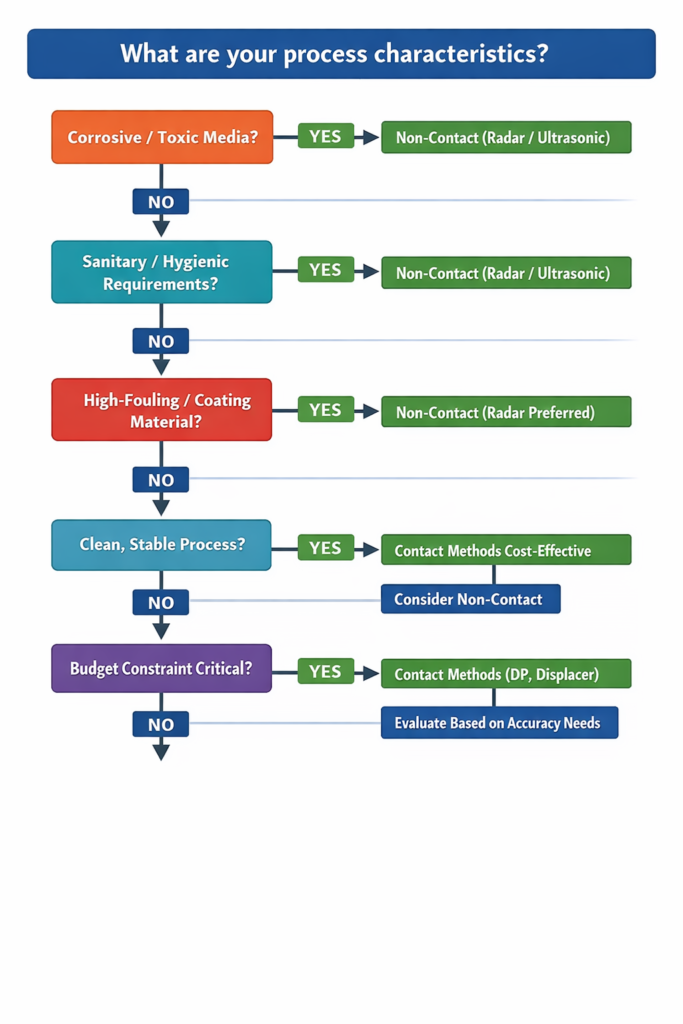
Selection Guide Tree:
Radar Level Transmitters: Precision Through Electromagnetic Waves
Radar level measurement has revolutionized industrial level measurement, offering unmatched versatility and reliability. By transmitting electromagnetic waves and measuring the time-of-flight of reflected signals, radar transmitters achieve precision previously impossible in challenging applications.
Principle of Operation
Radar level transmitters operate on the fundamental principle of time-domain reflectometry (TDR) and frequency-modulated continuous wave (FMCW) technology.
The Physics Behind Radar Measurement:
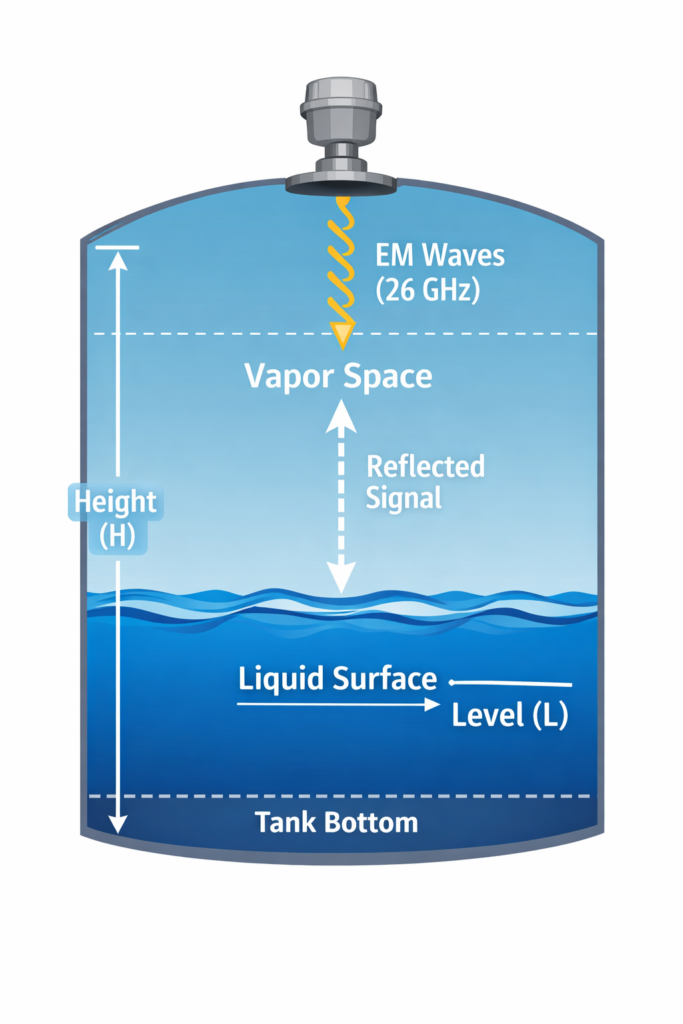
Electromagnetic waves travel at the speed of light (c = 3 × 10⁸ m/s in vacuum, slightly slower in air). When these waves encounter a material interface with different dielectric properties, a portion reflects back to the sensor.
The distance calculation formula:
D = (c × t) / 2
Where:
- D = Distance to liquid surface (m)
- c = Speed of electromagnetic propagation (m/s)
- t = Time of flight (round trip) (s)
- Division by 2 accounts for the round-trip travel
Level is then calculated as:
L = H – D
Where:
- L = Liquid level (m)
- H = Height reference (sensor position to tank bottom) (m)
- D = Measured distance (m)
The dielectric constant (εr) of the measured material significantly affects signal reflection. Materials with higher dielectric constants (water εr ≈ 80, hydrocarbons εr ≈ 2-4) produce stronger reflections, improving measurement reliability.
Transmission Methods
1. Through-Air Radar (Non-Contact)
Through-air radar transmitters mount on top of the tank, sending electromagnetic pulses through the vapor space. These systems typically operate at frequencies of 6 GHz (C-band) or 26 GHz (K-band).
Visual Representation:
26 GHz vs. 6 GHz: Which to Choose?
- 26 GHz (K-band): Narrower beam angle (3-4°), better for tall narrow tanks, smaller antennas, less affected by internal obstructions
- 6 GHz (C-band): Wider beam angle (10-15°), better for low dielectric materials, more economical, proven in extreme conditions
2. Guided Wave Radar (GWR)
Guided wave radar uses a probe (cable or rod) to guide electromagnetic pulses directly to the liquid surface, minimizing the effects of vapor, foam, and turbulence.
Visual Representation:
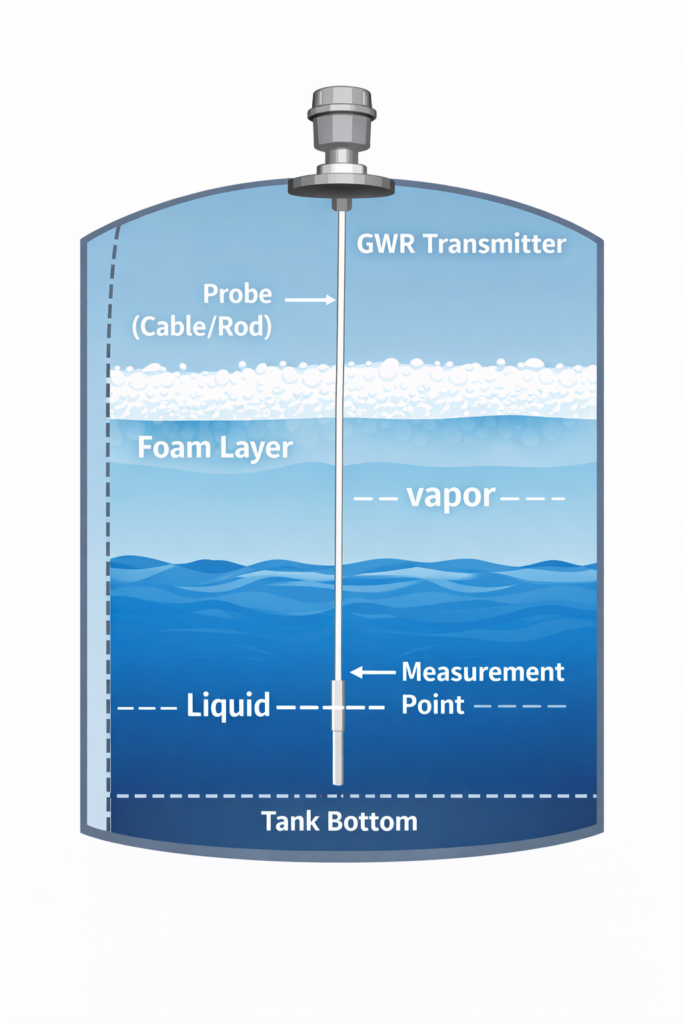
GWR excels in applications with:
- Heavy foam or vapor conditions
- Low dielectric materials (εr < 2)
- Interface measurement between two liquids
- Limited space where narrow beams are essential
Performance Analysis
Accuracy Specifications:
- Through-air radar: ±3 mm to ±15 mm depending on antenna and application
- Guided wave radar: ±1 mm to ±3 mm for liquid applications
- Repeatability: Typically ±0.5 mm
Response Time: Modern radar transmitters update measurements every 0.2-1 second, making them suitable for fast-changing level control applications.
Environmental Range:
- Temperature: -60°C to +400°C (specialized versions to +1000°C)
- Pressure: Full vacuum to 400 bar
- Suitable for explosive atmospheres with ATEX/IECEx certifications
Interference and Multipath Effects:
Internal tank obstructions (agitators, baffles, heating coils) can create false echoes. Advanced signal processing algorithms and sophisticated echo tracking features distinguish true level reflections from interference through:
- Multiple echo tracking and analysis
- Echo profile storage and comparison
- False echo suppression mapping
- Time-varying gain adjustments
Advantages
Unmatched Versatility: Radar works across an extraordinary range of applications—from cryogenic LNG at -162°C to molten sulfur at 150°C, from perfect vacuum to 400 bar pressure.
Low Maintenance: With no moving parts and non-contact operation, radar transmitters often operate maintenance-free for years. This translates to reduced downtime and lower lifecycle costs.
Immune to Process Conditions: Unlike ultrasonic sensors, radar isn’t affected by temperature gradients, vapor density changes, or pressure variations. Dust, mist, and foam cause minimal interference.
Safety in Hazardous Areas: Radar transmitters are available with comprehensive hazardous area approvals, making them ideal for petrochemical and gas processing applications.
Advanced Diagnostics: Modern radar transmitters feature sophisticated self-diagnostics, providing continuous monitoring of signal quality, echo strength, and potential issues before they cause measurement failures.
Limitations and Considerations
Initial Investment: Radar technology represents a higher upfront cost compared to traditional methods like DP or float systems. However, total cost of ownership often favors radar due to reduced maintenance.
Application Engineering Required: Proper antenna selection, mounting location, and configuration are critical. Incorrect installation can lead to poor performance in challenging applications.
Dielectric Sensitivity: Materials with very low dielectric constants (εr < 1.6) like liquefied gases may produce weak reflections. GWR or specialized antennas may be required.
Foam Challenges: While radar handles foam better than most technologies, dense, stable foam can still attenuate signals. Guided wave radar offers better performance in heavy foam applications.
Obstructions: While modern radars can map and ignore fixed obstructions, excessive internal structures may still create measurement challenges, particularly with through-air systems.
Guided Wave Radar (GWR): A Deeper Look
Guided wave radar deserves special attention as it solves many challenges faced by through-air radar in difficult applications.
Probe Configurations:
- Single Rod Probe: Rigid stainless steel rod, ideal for high-pressure applications and shorter distances (up to 6 meters)
- Flexible Cable Probe: Cable suspended with weight, suitable for longer measurements (up to 60 meters) and stilling wells
- Coaxial Probe: Two concentric tubes, optimal for low dielectric fluids and interface measurement
Interface Measurement Capability:
GWR excels at measuring the interface between two immiscible liquids (like oil and water) by detecting two reflection points:
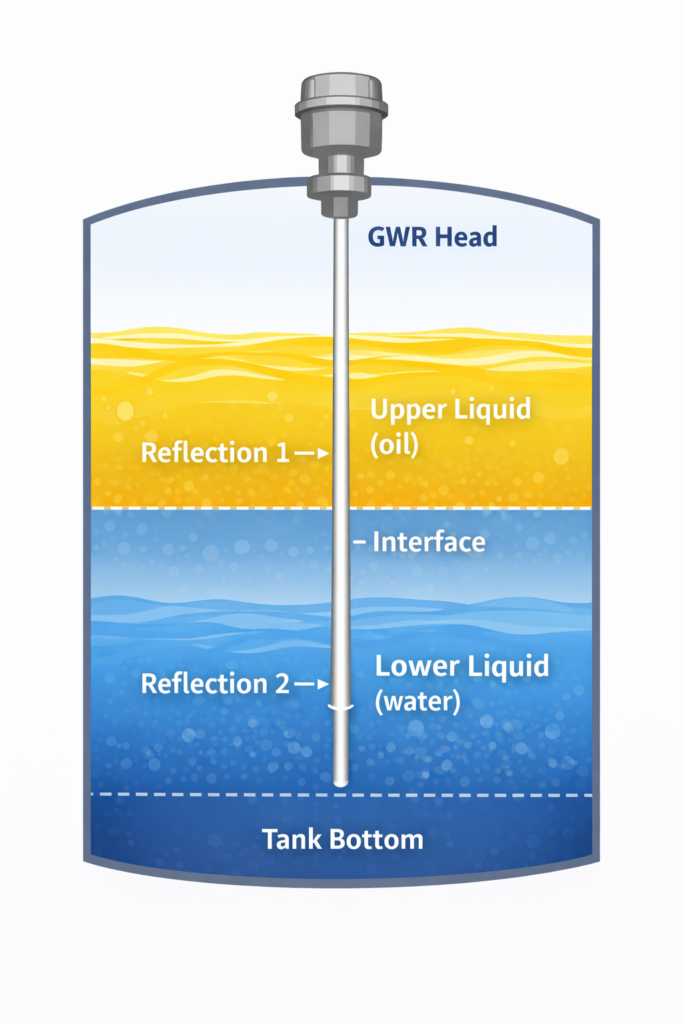
The difference in dielectric constants between the two liquids must be sufficient (typically Δεr > 10) for reliable interface detection.
Ultrasonic Level Transmitters: Non-Contact Measurement via Sound
Ultrasonic level measurement harnesses the power of sound waves beyond human hearing, offering a cost-effective, non-contact solution for countless applications. While radar dominates in extreme conditions, ultrasonics provide an excellent balance of performance and economy for many industrial processes.
Principle of Operation
Ultrasonic level transmitters emit high-frequency sound pulses (typically 20-200 kHz) that travel through the gas/vapor space above the measured material. When these sound waves encounter the liquid surface, they reflect back to the transducer.
The Fundamental Equation:
D = (v × t) / 2
Where:
- D = Distance to liquid surface (m)
- v = Speed of sound in the medium (m/s)
- t = Time of flight (round trip) (s)
Speed of Sound Calculation:
Unlike electromagnetic waves, sound speed varies significantly with temperature and gas composition:
v = 331.3 + (0.606 × T)
Where:
- v = Speed of sound (m/s)
- T = Temperature (°C)
- 331.3 m/s = Speed of sound at 0°C in air
At 20°C: v ≈ 343 m/s At 100°C: v ≈ 392 m/s
This 15% variation over temperature necessitates automatic temperature compensation in precision applications.
Level Calculation:
L = H – D
Where:
- L = Liquid level (m)
- H = Empty distance (sensor to tank bottom) (m)
- D = Measured distance from sensor to surface (m)
Transmission Method
Non-Contact Top-Mounted Configuration:
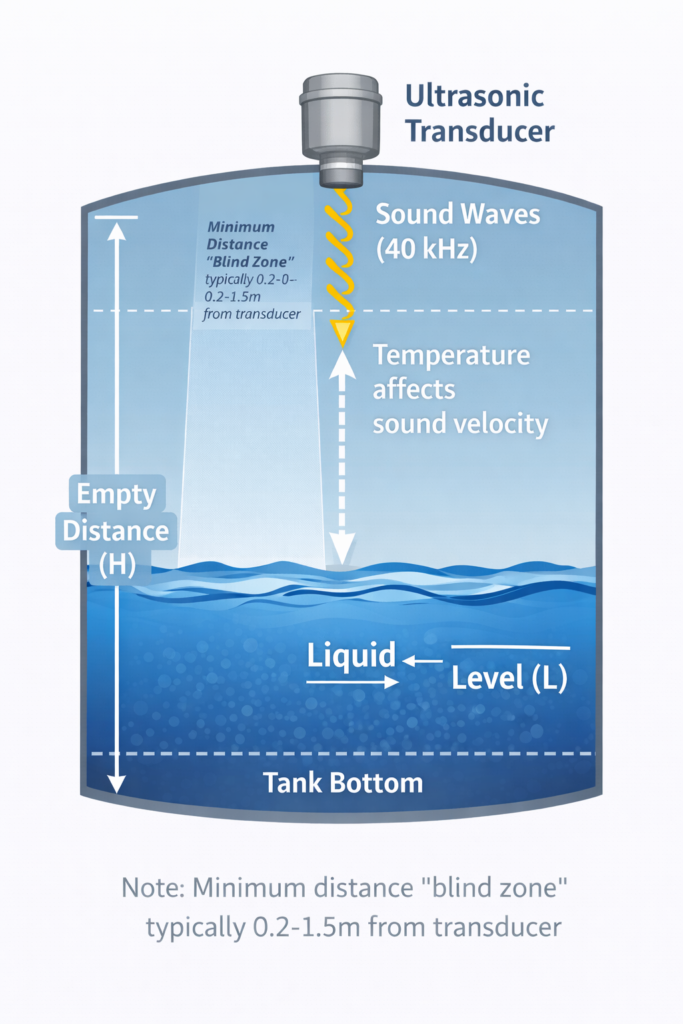
Transducer Technology:
Modern ultrasonic transmitters use piezoelectric crystals that convert electrical pulses into mechanical vibrations (sound waves) and vice versa. The same transducer typically serves as both transmitter and receiver.
Beam Angle Considerations:
Ultrasonic sensors emit a cone-shaped beam with angles typically ranging from 5° to 15°. This beam spread must be considered during installation:
Beam diameter at liquid surface: BD = 2 × D × tan(θ/2)
Where:
- BD = Beam diameter at surface (m)
- D = Distance to surface (m)
- θ = Beam angle (degrees)
For a sensor with 10° beam angle measuring a level 5m away: BD = 2 × 5 × tan(5°) ≈ 0.87 m
This means the beam illuminates a circle approximately 0.87m in diameter, so tank diameter should exceed this significantly to avoid wall reflections.
Performance Analysis
Accuracy and Range:
- Typical accuracy: ±0.25% of measured range (±3-10 mm)
- Maximum range: 0.5-40 meters depending on application and sensor design
- Blind zone: 0.2-1.5 meters (dead zone where measurement isn’t possible)
Measurement Rate: Update times range from 0.5-5 seconds depending on distance and averaging settings. Longer distances require more time for sound wave propagation.
Environmental Limitations:
Temperature Effects:
- Operating range: -40°C to +80°C (standard), some specialized versions to +200°C
- Temperature compensation required for accuracy
- Rapid temperature changes create measurement instability
Pressure Considerations:
- Most effective at atmospheric or near-atmospheric pressure
- High vacuum reduces sound transmission significantly
- Pressure changes affect gas density and sound velocity
Vapor and Dust Interference:
- Heavy vapor or dust attenuates ultrasonic signals
- Condensation on transducer face blocks signal transmission
- Turbulent vapor layers cause signal scattering
Advantages
Economic Value: Ultrasonic transmitters offer excellent performance at 30-50% the cost of comparable radar systems, making them ideal for budget-conscious projects or applications with multiple measurement points.
Simple Installation: Mounting on top of tanks without process penetration, ultrasonics install quickly with minimal downtime. Standard threaded or flanged connections simplify retrofits.
Proven Reliability: Decades of successful implementation across industries demonstrate ultrasonics’ reliability in appropriate applications. Solid-state electronics ensure long operational life.
No Calibration Required: Once commissioned with the empty distance setting, ultrasonic transmitters require no routine calibration or maintenance in most applications.
Safe for Flammable Atmospheres: Available with comprehensive hazardous area certifications (ATEX, IECEx, FM, CSA), ultrasonics safely measure in potentially explosive environments.
Chemical Compatibility: Since there’s no contact with the process material, chemical compatibility issues are eliminated—perfect for corrosive applications.
Limitations and Considerations
Vapor and Foam Sensitivity: Dense foam absorbs ultrasonic energy rather than reflecting it, making level measurement unreliable. Heavy vapor conditions scatter sound waves, degrading accuracy.
Temperature Gradients: Vertical temperature stratification in the vapor space bends ultrasonic waves, potentially causing measurement errors. This phenomenon, called refraction, is particularly problematic in tall tanks with significant top-to-bottom temperature differences.
Agitation and Turbulence: Vigorous surface agitation creates inconsistent reflections, causing noisy or erratic signals. Averaging algorithms help but can slow response time.
Pressure Limitations: Ultrasonic measurement becomes unreliable at high vacuum conditions (< 0.1 bar absolute) where sound transmission is severely limited.
Obstruction Issues: Any object in the beam path (fill pipes, heating coils, structural supports) can create false echoes. Unlike radar, ultrasonics have limited ability to differentiate between multiple echoes.
Condensation Problems: Moisture accumulation on the transducer face blocks sound transmission. Installations in humid environments or applications with significant temperature cycling may require transducer heating or protective measures.
Application Sweet Spot: Ultrasonics work best in clean liquids with minimal turbulence, stable temperature, near-atmospheric pressure, and moderate vapor conditions—think water treatment, bulk storage, and simple tank monitoring.
Differential Pressure (DP) Transmitters: The Workhorse of Level Measurement
For over 70 years, differential pressure transmitters have been the backbone of industrial level measurement. Despite the advent of sophisticated radar and ultrasonic systems, DP transmitters remain indispensable due to their simplicity, reliability, and cost-effectiveness in appropriate applications.
Principle of Operation
DP level measurement exploits a fundamental principle of fluid mechanics: hydrostatic pressure. The pressure at the bottom of a liquid column is directly proportional to the liquid height and density.
The Hydrostatic Pressure Equation:
P = ρ × g × h
Where:
- P = Pressure at measurement point (Pa)
- ρ = Liquid density (kg/m³)
- g = Gravitational acceleration (9.81 m/s²)
- h = Liquid height above measurement point (m)
Level Calculation from Pressure:
Rearranging the equation:
h = P / (ρ × g)
In practical units:
h = ΔP / (SG × 0.098)
Where:
- h = Level (meters)
- ΔP = Differential pressure (kPa)
- SG = Specific gravity of liquid (dimensionless)
- 0.098 = Conversion factor for kPa to meters water column
Example Calculation:
A DP transmitter measures 49 kPa on a water tank (SG = 1.0):
h = 49 / (1.0 × 0.098) = 5 meters
For gasoline (SG = 0.75) giving the same pressure:
h = 49 / (0.75 × 0.098) = 6.67 meters
This demonstrates why accurate density knowledge is critical for DP level measurement.
Transmission Method
Configuration Options:
1. Open Tank (Atmospheric) Measurement:
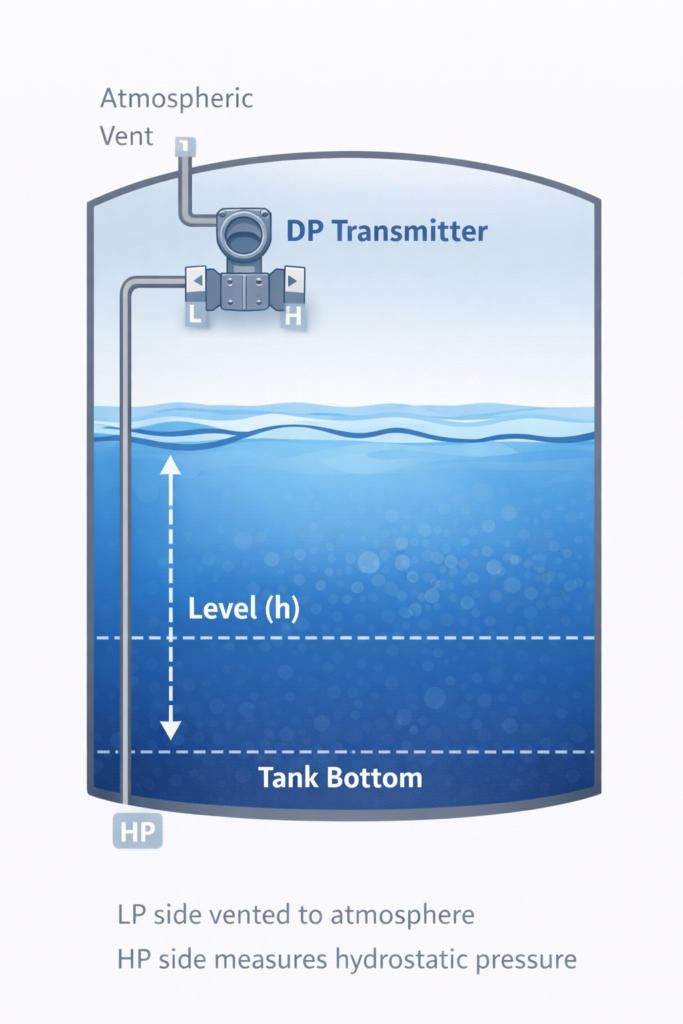
In atmospheric tanks, the low-pressure side vents to atmosphere while the high-pressure side connects to the tank bottom (or lower side connection). The transmitter output directly indicates level.
2. Closed Tank (Pressurized) Measurement:
In pressurized vessels, gas pressure affects both connections equally. The differential pressure cancels out the gas pressure effect, measuring only the liquid column.
3. Wet Leg Configuration (for condensing vapors):
When vapor condenses in sensing lines, a wet leg (reference leg filled with known liquid) provides a stable reference pressure. The transmitter compensates for the wet leg height in its calibration.
4. Dry Leg with Seal Systems (for viscous/corrosive fluids):
Diaphragm seals with capillary fill systems protect the transmitter from corrosive, coating, or crystallizing materials. The seal adds complexity but enables DP measurement in challenging applications.
Performance Analysis
Accuracy:
- Standard DP transmitters: ±0.075% to ±0.25% of calibrated span
- When converted to level: Accuracy depends on span vs. tank height
- For a 5-meter tank with 50 kPa span: ±4-13 mm level uncertainty
Density Compensation:
Level accuracy is directly tied to density accuracy. A 5% density error produces a 5% level error. For varying density processes, consider:
h_actual = h_measured × (ρ_calibration / ρ_actual)
Solutions for varying density:
- Online density measurement with calculation
- Temperature compensation (for temperature-sensitive fluids)
- Regular recalibration based on lab samples
- Switching to radar or other density-independent technologies
Response Time: DP transmitters respond quickly (0.1-1 second) to actual pressure changes, but system response time includes:
- Impulse line fill time
- Damping settings to smooth turbulent fluctuations
- PLC/DCS input filtering
Total system response: 1-10 seconds typically
Environmental Range:
- Temperature: -40°C to +350°C (process temperature at seals)
- Pressure: Full vacuum to 400 bar depending on transmitter rating
- Compatible with all liquids suitable for wetted materials
Advantages
Proven Reliability: Seven decades of industrial use have established DP transmitters as extraordinarily reliable. Their simple operating principle means fewer failure modes.
Low Cost: DP transmitters represent the most economical continuous level measurement solution, often costing 20-40% of equivalent radar systems.
Universal Acceptance: Every plant has DP transmitter expertise. Maintenance personnel understand them, spare parts are readily available, and troubleshooting is straightforward.
No Calibration for Physical Changes: Unlike ultrasonic or radar systems that must be reconfigured when tank geometry changes, DP transmitters simply measure pressure—they don’t “know” about tank dimensions.
Excellent Accuracy in Stable Applications: When density is constant and properly compensated, DP transmitters deliver excellent accuracy at minimal cost.
Multivariable Capability: Modern smart DP transmitters can simultaneously measure differential pressure, static pressure, and temperature, enabling advanced calculations and diagnostics.
Wide Material Compatibility: With appropriate seal materials, DP transmitters handle virtually any liquid—from sulfuric acid to molten chocolate.
Limitations and Considerations
Density Dependence: This is the fundamental limitation. Any density variation introduces measurement error unless compensated. Processes with temperature-varying density, mixing operations, or changing compositions challenge DP measurement.
Installation Complexity: Proper installation requires expertise:
- Impulse lines must be properly sloped (typically 1:12 minimum)
- Connections must be located to prevent gas/vapor trapping (HP side) and sediment buildup
- Fill fluids must be compatible and properly maintained
- Winterization may be required for outdoor installations
Maintenance Requirements:
- Impulse lines can plug, freeze, or leak
- Fill fluids must be checked and replenished
- Wet legs require periodic verification
- Diaphragm seals can fail over time
Mounting Location Restrictions: The transmitter must be mounted at or below the lowest measured level. In deep vessels, this may place electronics in difficult-to-access locations or harsh environments.
Interface Measurement Challenges: While DP can theoretically measure interfaces, it requires precise knowledge of both liquid densities and is generally inferior to guided wave radar for this application.
Capillary Seal Limitations:
- Temperature gradients along capillaries introduce errors
- Capillary length limits (typically 50m maximum)
- Capillary damage can contaminate fill fluid
- Response time increases significantly with seals
Not Suitable For:
- Foam-prone applications (pressure measurement point submerged in foam)
- Low-density, low-level applications (insufficient pressure to measure accurately)
- Frequent density variations without compensation
- Applications where impulse line maintenance is impractical
Displacer Level Transmitters: Buoyancy-Based Measurement
Displacer level transmitters represent one of the oldest continuous level measurement technologies, yet they remain relevant in specific applications where their unique characteristics provide advantages over modern alternatives. Understanding buoyancy-based measurement is essential for maintaining legacy systems and selecting the right technology for interface applications.
Principle of Operation
Displacer level transmitters operate on Archimedes’ principle of buoyancy: An object immersed in fluid experiences an upward force equal to the weight of the fluid displaced.
Archimedes’ Principle:
F_buoyant = ρ_fluid × V_displaced × g
Where:
- F_buoyant = Buoyant force (N)
- ρ_fluid = Fluid density (kg/m³)
- V_displaced = Volume of fluid displaced (m³)
- g = Gravitational acceleration (9.81 m/s²)
The Displacer Mechanism:
A cylindrical or specially-shaped displacer hangs vertically in the vessel. As level rises, more of the displacer becomes submerged, increasing buoyant force and reducing the apparent weight measured by the torque tube or force sensor.
Weight vs. Level Relationship:
W_apparent = W_displacer – F_buoyant
W_apparent = W_displacer – (ρ_fluid × V_submerged × g)
For a cylindrical displacer:
V_submerged = π × r² × h_submerged
Where:
- W_apparent = Apparent weight measured (N)
- W_displacer = Actual weight of displacer in air (N)
- r = Radius of cylindrical displacer (m)
- h_submerged = Height of liquid on displacer (m)
The key insight: As level increases, apparent weight decreases proportionally, creating a linear relationship between level and measured force.
Interface Measurement:
Displacers excel at measuring the interface between two immiscible liquids of different densities:
W_apparent = W_displacer – (ρ_upper × V_upper + ρ_lower × V_lower) × g
The difference in buoyancy between the two fluids creates a distinct change in apparent weight at the interface point.
Transmission Method
Typical Installation Configuration:
Mounting Options:
- Side-mounted chamber: External cage provides protection and allows displacer replacement without vessel shutdown
- Direct vessel mounting: Displacer suspends directly inside vessel, suitable for large tanks
- Bridle configuration: Top and bottom connections with chamber, typical in refining applications
Technology Variations:
Torque Tube Design: Traditional mechanical linkage converts vertical force to rotational torque, measured by strain gauges or LVDT sensors. Highly reliable but with moving parts.
Cable/Spring Design: Displacer hangs on cable or spring, with force measured by load cell. Simpler design, suitable for longer measurement ranges.
Performance Analysis
Measurement Range:
- Typical: 0.5 to 6 meters (displacer length determines range)
- Extended ranges possible with multiple displacers
- Interface measurement ranges: 0.3 to 3 meters typically
Accuracy:
- Standard: ±0.5% to ±1% of span
- High-performance models: ±0.25% of span
- Accuracy depends heavily on density stability
Density Requirements:
For reliable measurement, minimum specific gravity differences:
- Single liquid level: SG > 0.5
- Interface measurement: ΔSG > 0.1 between fluids
Response Time:
- Mechanical inertia limits response: 1-5 seconds typical
- Damping adjustments reduce noise but slow response
- Not suitable for fast-changing levels
Environmental Capability:
- Temperature: -200°C to +400°C
- Pressure: Full vacuum to 200 bar
- Suitable for hazardous area classification
Advantages
Interface Measurement Excellence: Displacers remain one of the most reliable technologies for measuring liquid-liquid interfaces, particularly in hydrocarbon processing where clear separation exists.
Density Independent Operation: Unlike DP transmitters, displacers measure actual buoyancy change rather than pressure, making them less sensitive to density variations within reasonable ranges.
No Electronics in Process: The measuring element (displacer) is purely mechanical, with electronics in a separate housing. This provides excellent reliability in harsh process environments.
Proven Track Record: Decades of successful operation in refineries and chemical plants demonstrate exceptional long-term reliability when properly maintained.
High Pressure/Temperature Capability: Mechanical construction allows operation in extreme conditions where electronic sensors might fail.
Visual Verification: External chamber installations allow visual inspection of level through sight glasses, providing independent verification.
Limitations and Considerations
Coating and Buildup: Process materials that coat or crystallize on the displacer change its volume and weight, introducing measurement errors. Regular cleaning may be required in fouling services.
Mechanical Wear: Moving parts (torque tubes, bearings, springs) wear over time, requiring periodic maintenance and calibration. This is the primary maintenance driver for displacer systems.
Installation Complexity:
- Requires substantial space for external chambers
- Mounting orientation is critical
- Impulse lines need proper design and maintenance
- Chamber sizing must match process conditions
Limited Range: Physical displacer length limits measurement span. Tanks requiring >6 meter measurement ranges may need multiple units or alternative technologies.
Turbulence Sensitivity: Vigorous process turbulence can cause displacer movement or vibration, introducing noise into the signal. Damping helps but reduces response time.
Calibration Requirements:
- Must be calibrated for specific fluid density
- Density changes require recalibration
- Periodic calibration verification needed due to mechanical wear
Not Suitable For:
- Slurries with suspended solids (coating issues)
- Highly viscous materials (displacer movement restricted)
- Low-density fluids (insufficient buoyant force)
- Sanitary/hygienic applications (chambers harbor bacteria)
- Applications requiring minimal maintenance
Modern Alternatives: In many traditional displacer applications, guided wave radar now offers superior performance with lower maintenance. Evaluate whether legacy displacer systems should be upgraded during turnarounds.
Diaphragm-Type Level Transmitters for Open Tanks: Simplicity Meets Reliability
For open atmospheric tanks containing clean to moderately dirty liquids, diaphragm-type level transmitters offer an elegantly simple solution. These submersible or tank-bottom-mounted instruments provide reliable measurement without the complexity of impulse lines or external chambers.
Principle of Operation
Diaphragm level transmitters measure hydrostatic pressure at a fixed point in the tank, just like DP transmitters, but with direct contact between the process fluid and a pressure-sensing diaphragm.
The Same Fundamental Physics:
P = ρ × g × h
Therefore:
h = P / (ρ × g)
Or in practical terms:
h = P / (SG × 9.81)
Where:
- h = Liquid height above sensor (m)
- P = Gauge pressure measured (kPa)
- SG = Specific gravity of liquid
- 9.81 = Gravitational constant (kPa/m per SG unit)
Example: A water tank (SG = 1.0) with sensor at bottom reading 98.1 kPa: h = 98.1 / (1.0 × 9.81) = 10 meters
The difference from traditional DP transmitters is the direct measurement approach—no impulse lines, no separate high/low connections, just a single pressure sensor at the reference point.
Transmission Method
Installation Configurations:
1. Submersible Probe Installation:
Submersible probes drop directly into the tank, suspended by a cable that contains both power/signal conductors and a vent tube to reference atmospheric pressure. Installation is simple: lower the probe to the desired depth and secure the cable.
2. Tank Bottom Flange Mount:
Flange-mounted sensors install at the tank bottom with the sensing diaphragm flush to the tank interior. This eliminates dead zones and allows complete tank drainage.
3. Side-Mount Configuration:
Side-mounted transmitters measure pressure at their installation point. Level is calculated by adding the height from sensor to tank bottom.
Sensor Technology:
Modern diaphragm transmitters use:
- Piezoresistive silicon sensors: High accuracy, excellent stability
- Capacitive ceramic sensors: Chemical resistance, high overload protection
- Strain gauge metal diaphragms: Rugged construction for harsh environments
All versions convert pressure-induced diaphragm deflection into an electrical signal, typically 4-20 mA output.
Performance Analysis
Accuracy Specifications:
- Standard accuracy: ±0.25% to ±0.5% of span
- High-performance models: ±0.1% of span
- Long-term stability: ±0.1% per year typical
Measurement Range:
- Submersible probes: 0.5 to 250 meters water column
- Flush-mount sensors: 0.1 to 50 meters typical
- Range selection based on maximum pressure exposure
Over-Pressure Protection: Most diaphragm transmitters withstand 2-10× rated pressure without damage, protecting against water hammer, pump surges, or installation errors.
Temperature Effects:
- Operating range: -10°C to +80°C (standard)
- High-temp versions: up to +150°C
- Temperature compensation maintains accuracy across range
Response Time: Fast electrical response (< 100 ms) makes diaphragm transmitters excellent for control applications. No impulse line lag time.
Material Compatibility:
Wetted Materials Available:
- Stainless steel 316L (most common)
- Hastelloy C (strong acids)
- Titanium (seawater, chlorides)
- Tantalum (extreme corrosion)
- PTFE/FEP coatings (chemical resistance with mechanical protection)
Diaphragm selection is critical—the sensor directly contacts the process fluid continuously.
Advantages
Installation Simplicity: No impulse lines, no wet legs, no fill fluids—just mount the sensor and connect power/signal. Submersible probes require no tank penetration at all.
Minimal Maintenance: With no impulse lines to plug or freeze, maintenance is virtually eliminated. In clean fluids, submersible sensors may operate 10+ years without service.
Space Efficiency: Compact design requires minimal space. Submersible probes work in tight installations where traditional DP transmitter mounting would be impractical.
Complete Tank Drainage: Flush-mount diaphragm sensors allow tanks to drain completely, critical in batch processes requiring total emptying between campaigns.
Excellent Low-Level Accuracy: Unlike radar or ultrasonic with dead zones, diaphragm sensors measure accurately down to zero level.
Cost-Effective for Multiple Tanks: When monitoring many atmospheric tanks, submersible probes with remote-mount electronics offer significant cost savings versus radar or ultrasonic systems.
Sanitary Designs Available: Flush diaphragm sensors with smooth surfaces meet 3-A sanitary standards for food, beverage, and pharmaceutical applications.
Limitations and Considerations
Open Tank Restriction: Standard diaphragm transmitters work only on vented/atmospheric tanks. Pressurized vessels require differential pressure measurement or specialized sealed sensors.
Density Dependence: Like all hydrostatic methods, accuracy depends on constant, known density. Temperature variations affecting density require compensation.
Limited Chemical Compatibility: Despite various materials, some extremely aggressive chemicals may attack even exotic diaphragm materials. Verify compatibility thoroughly.
Submersible Probe Challenges:
- Cable length limits (typically 100-200 meters maximum)
- Cable damage from operators, equipment, or floating debris
- Vent tube can clog with moisture or contamination
- Not suitable for turbulent or agitated applications
Abrasion Concerns: In applications with suspended solids or abrasive materials, continuous diaphragm contact may cause wear, reducing sensor life. Consider protective coatings or alternative technologies.
Hydrostatic Head Only: Cannot measure beyond physical tank height. For tall vessels (>20-30m), consider radar for longer range without multiple sensors.
Mounting Position Critical: Side-mounted sensors must account for mounting height in calculations. Errors in recorded mounting position cause systematic level errors.
Not Ideal For:
- Pressurized/closed vessels (use DP transmitters)
- Highly viscous materials that coat sensors
- Turbulent, churning applications
- Applications requiring zero maintenance access to tank
Best Applications:
- Water and wastewater treatment
- Chemical bulk storage tanks
- Food and beverage process tanks
- Groundwater monitoring wells
- Day tanks and collection sumps
- Any atmospheric tank with moderate conditions
Industrial Applications and Strategic Recommendations: Making the Right Choice
Selecting the optimal level measurement technology isn’t just about technical specifications—it’s about understanding your complete operational context. The “best” technology differs dramatically between a pharmaceutical clean room, a crude oil tank farm, and a wastewater treatment plant.
Technology Selection Matrix
Here’s a comprehensive decision matrix to guide your selection:
| Application Characteristics | 1st Choice | 2nd Choice | Avoid |
|---|---|---|---|
| Clean water, atmospheric tank | Submersible DP | Ultrasonic | Radar (over-eng.) |
| Crude oil storage tank | Radar (26 GHz) | Guided Wave Radar | Ultrasonic (vapor) |
| Pressurized reactor | Radar (26 GHz) | DP w/ Seals | Ultrasonic |
| Interface measurement (oil/water) | Guided Wave Radar | Displacer | DP (poor) |
| Corrosive chemical, open tank | Radar (PTFE antenna) | Ultrasonic | DP (maintenance) |
| Sanitary/hygienic process | Radar (flush) | Ultrasonic | Displacer |
| Slurry/solids suspension | Radar (26 GHz) | None ideal | Ultrasonic, DP |
| High foam application | Guided Wave Radar | Radar (low freq) | Ultrasonic |
| Extreme temperature (>200°C) | Radar | DP w/ Seals | Ultrasonic |
| High vacuum (<0.1 bar) | Radar | DP | Ultrasonic |
| Cryogenic LNG (-162°C) | Radar (special) | DP (specialized) | Ultrasonic |
| Multiple small tanks | Submersible DP | Ultrasonic | Radar (cost) |
| Custody transfer accuracy | Radar (±1mm) | Servo Tank Gauge | DP |
| Budget-constrained, simple | DP Transmitter | Ultrasonic | Radar |
Industry-Specific Recommendations
Petroleum Refining & Petrochemicals:
Recommendations:
- Primary: 26 GHz radar for crude, refined products, chemicals
- Backup: Point level switches for high-level alarm (independent system)
- Custody transfer: High-accuracy radar (±1mm) or servo gauges
- Interface: Guided wave radar for desalter, water boots
Water & Wastewater Treatment:
Recommendations:
- Primary: Submersible DP transmitters for most tanks/basins
- Influent channels: Ultrasonic (non-contact, no fouling)
- Chemical storage: Radar or ultrasonic depending on size
- Digesters: Radar (handles foam and biogas)
Food & Beverage Processing:
Recommendations:
- Process tanks: Flush-mount radar or sanitary diaphragm sensors
- Mixing vessels: Radar (handles agitation)
- Ingredient tanks: Ultrasonic (simple, effective for liquids)
- Avoid: Displacers, external chambers (harbor bacteria)
Chemical Manufacturing:
Recommendations:
- Corrosive: Radar with exotic materials (PTFE, PFA, ceramic)
- Batch reactors: Radar or DP with diaphragm seals
- Solvent tanks: Radar (no vapor issues)
- Exothermic reactions: Radar (temperature-independent)
Pharmaceutical Manufacturing:
Recommendations:
- Primary: Radar (flush or non-contact) for FDA/GMP compliance
- Clean utilities: Ultrasonic for WFI, pure steam condensate
- Solvent drums: Radar with ATEX certification
- Critical: Full documentation, calibration records, material certs
Safety Integrity Level (SIL) Considerations
For critical safety applications, instrument selection must consider functional safety:
SIL-Rated Applications:
- Overfill prevention (high-level shutdown)
- Low-level protection (pump dry-run prevention)
- Emergency shutdown systems (ESD)
Technology Suitability for SIL:
| Technology | SIL Capability | Notes |
|---|---|---|
| Radar | SIL 2/3 | Excellent diagnostics, proven reliability |
| Ultrasonic | SIL 2 | Limited by vapor/foam sensitivity |
| DP | SIL 2 | Requires impulse line monitoring |
| Displacer | SIL 1/2 | Mechanical wear limits reliability |
| Guided Wave Radar | SIL 2/3 | Excellent for interface safety |
Key Principle: Safety systems require independent redundancy. Never rely on a single continuous level measurement for safety-critical shutdowns—always include independent point-level switches or redundant transmitters.
Total Cost of Ownership Analysis
Looking beyond purchase price reveals the true economics:
20-Year TCO Comparison (Typical Refinery Tank):
This example demonstrates: Higher initial investment in radar pays back through dramatically reduced maintenance and better reliability.
TCO Factors to Consider:
- Installation complexity and labor
- Ongoing calibration requirements
- Maintenance frequency and cost
- Spare parts inventory
- Downtime impact on production
- Energy costs (where applicable)
- Operator training requirements
Practical Installation Guidelines
General Best Practices:
- Antenna/Sensor Positioning:
- Center-mount in smaller vessels
- Avoid fill stream impingement
- Minimum distance from walls: 0.3m (radar), 0.5m (ultrasonic)
- Clear line-of-sight to liquid surface
- Nozzle Selection:
- Radar: 3″ or 4″ minimum for most antennas
- Ultrasonic: 2″ often sufficient
- Consider future maintenance access
- Environmental Protection:
- Sunshade for direct sun exposure
- Weatherproof enclosures (NEMA 4X/IP66)
- Heat tracing for freezing environments
- Vibration isolation where needed
- Grounding and Lightning Protection:
- Proper grounding prevents measurement noise
- Lightning protection on tall tanks
- Surge protection on signal lines
- Commissioning Documentation:
- Detailed configuration settings
- Calibration certificates
- Echo curve/profile baseline (radar)
- As-built installation drawings
Emerging Technologies and Future Trends
Innovations on the Horizon:
AI-Enhanced Signal Processing: Machine learning algorithms analyzing echo patterns to distinguish true level from interference, automatically optimizing performance over time.
Wireless and IIoT Integration: Battery-powered radar sensors with 10+ year life, transmitting via LoRaWAN, WirelessHART, or 5G industrial networks. Eliminating wiring reduces installation costs 60-80%.
Predictive Maintenance: Instruments monitoring their own health, predicting failures before they occur based on signal quality degradation, temperature trends, and electronics diagnostics.
Multi-Variable Measurement: Single instruments simultaneously measuring level, temperature, pressure, density, and interface position—replacing multiple devices with one smart sensor.
Radar-Ultrasonic Hybrids: Combined technologies providing redundancy and extended capability, automatically switching based on process conditions.
Strategic Recommendations Summary
Making Your Decision:
1. Start with Process Requirements:
- What materials am I measuring?
- What are the operating conditions?
- What accuracy do I need?
- What are the safety implications?
2. Evaluate Total Cost:
- Look beyond purchase price
- Include 20-year maintenance
- Consider downtime costs
- Factor in operator burden
3. Plan for the Future:
- Will processes change?
- Can I upgrade firmware vs. replacing hardware?
- Is remote calibration/diagnostics possible?
- What’s the spare parts strategy?
4. Consider Standardization:
- Fewer technologies = simpler training
- Bulk purchasing power
- Streamlined spare parts inventory
- But don’t force one technology everywhere
5. Test Before Commitment:
- Request demo units for critical applications
- Validate performance in actual process conditions
- Involve operators in evaluation
- Check manufacturer support quality
Final Thought: The best level measurement technology is the one that delivers reliable, accurate measurement with minimal operational burden over its entire lifecycle. Sometimes that’s a sophisticated radar system; sometimes it’s a simple submersible probe. Understanding the principles, technologies, and applications empowers you to make that decision with confidence.
Conclusion: Mastering Level Measurement for Operational Excellence
Level measurement may seem like a basic industrial function, but as we’ve explored, it’s a sophisticated discipline requiring deep understanding of physical principles, technology capabilities, and application requirements. Whether you’re specifying instruments for a new facility, troubleshooting existing systems, or planning upgrades, the knowledge shared in this guide positions you to make informed, strategic decisions.
Key Takeaways:
- Match technology to application: No single technology wins everywhere; success comes from thoughtful selection based on complete process understanding
- Think lifecycle, not purchase price: Total cost of ownership often favors higher initial investment in lower-maintenance technologies
- Safety is paramount: Critical applications demand redundancy, SIL-rated equipment, and defense-in-depth strategies
- Stay current: Emerging wireless, AI-enhanced, and multi-variable technologies offer compelling advantages in new installations
The evolution from simple float switches to millimeter-accurate radar systems reflects broader industrial digitalization trends. Today’s level instruments are intelligent devices providing not just measurement but comprehensive process insight, predictive maintenance alerts, and seamless integration with plant-wide control and optimization systems.
As you implement these technologies in your facilities, remember that proper installation, commissioning, and maintenance remain just as critical as technology selection. The most sophisticated radar transmitter won’t perform if poorly installed; conversely, a well-engineered DP transmitter solution can outperform a poorly-applied radar system.
Whether you’re measuring water in a treatment plant, crude oil in a refinery, or pharmaceutical ingredients in a clean room, the principles remain constant while the technologies adapt to meet increasingly demanding requirements for safety, efficiency, and environmental protection.
What level measurement challenges are you facing in your operations? Share your experiences and questions in the comments below!